To go along with today’s episode on lumbar spinal stenosis treatment, I have a nice infographic to share…
Sign up to receive FREE: Lumbar Spinal Stenosis – The Evidence Based Cheat Sheet
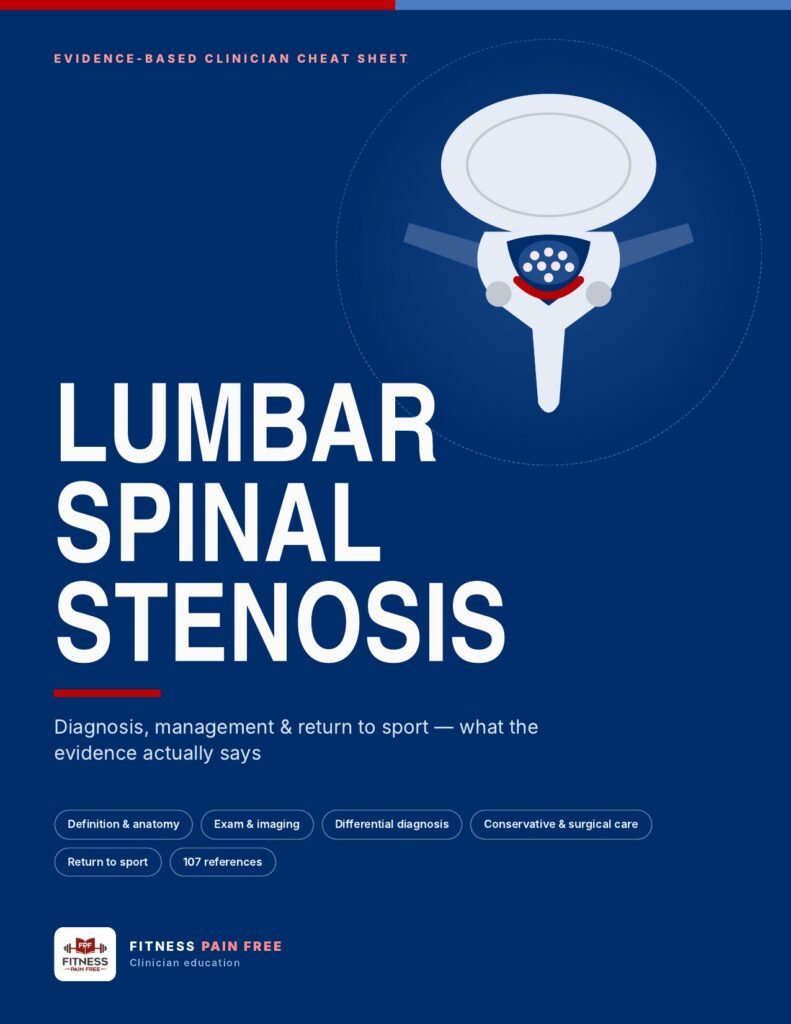
Click HERE to Download FREE
In today’s video we go over lumbar spinal stenosis treatment and what actually works in physical therapy:
Your patient can only walk a few blocks before their legs give out, and the only thing that helps is sitting down or leaning on a shopping cart. Flexion exercises are a start… but what else should be in your plan?
In this video, we walk through a complete physical therapy approach for lumbar spinal stenosis and neurogenic claudication: patient education, activity modification, mobility, neural mobilization, strength progressions, aerobic exercise, manual therapy and walking strategies. It’s built for physical therapists, PTAs and rehab clinicians working with active adults who want to connect the research with practical exercise demonstrations and adapt treatment to the individual patient.
What You’ll Learn About Lumbar Spinal Stenosis Treatment
- How to explain nerve compression to your patients and modify aggravating activities
- Hip flexor, thoracic and lumbar mobility options
- Neural glides and stretches for the lower extremity
- Side plank, bridge, leg raise, squat and Superman strengthening progressions
- Cycling and supported walking options for aerobic exercise
- Impairment-based manual therapy, standing posture and gait cues
Spinal Stenosis Physical Therapy: Key Points From the Research
- Physical therapy is first-line care. Lumbar spinal stenosis affects an estimated 103 million people worldwide, and first-line treatment is activity modification, pain relief and physical therapy. Without surgery, about one-third of patients improve over 3 years, about half stay the same and 10–20% get worse (Katz 2022).
- Surgery isn’t a clear winner. A Cochrane review of 5 RCTs (643 participants) found no clear benefit of surgery over non-surgical care, while surgical side effects ranged from 10% to 24% and none were reported with conservative treatment (Zaina 2016).
- Supervised PT can match surgery. When patients were matched on baseline severity, 6 weeks of supervised physical therapy (manual therapy, tailored exercise, cycling and body-weight-supported treadmill walking) produced 1-year outcomes similar to decompression surgery (Minetama 2022).
- Supervision matters. In an RCT of 86 patients, 60.5% of the supervised PT group reached a meaningful improvement in symptom severity vs 32.6% with a home program alone, and only 7.0% had surgery at 1 year vs 23.3% (Minetama 2021).
- Go beyond flexion exercises. Across 13 trials and 1,440 participants, successful programs more often included stretching, strength and trunk exercises, fitness work (especially cycling) and psychologically informed approaches (Comer 2024).
- Cycling and manual therapy earn their place. A review of 12 RCTs (944 patients) found 6 weeks of cycling reduced disability more than weight-supported walking, and manual therapy plus exercise beat home or group exercise for pain, walking tolerance and disability (Temporiti 2022).
- Exercise is safe even before surgery. In a 6-week prehab program for patients awaiting stenosis surgery, 88% of sessions were completed without an adverse event, with gains in leg pain, back extensor endurance and walking capacity (Marchand 2019).
- Use cadence to dose walking. Roughly 100 steps per minute is a practical marker of moderate-intensity walking in adults (Tudor-Locke 2018), a simple target as your patient’s walking tolerance improves.
Our goal? Help you build a lumbar spinal stenosis treatment plan that gets your patients walking farther and back to the activities they love.
Stop guessing with your lumbar spine patients.
Inside FPF Insiders Academy you get the full Lumbar Radicular Pain Master Course plus 35+ more that take common pathologies from first visit to discharge, 50+ evidence-based cheat sheets, and unlimited CEUs for PTs, PTAs and ATs.
Video Timestamps
- 0:00 Why care about stenosis?
- 0:52 Patient education
- 1:47 Activity modification
- 3:18 Free stenosis cheat sheet
- 3:54 Stretching and mobility
- 4:56 Hip flexor mobility
- 7:13 Thoracic mobility
- 8:30 Lumbar mobility
- 11:04 Neural mobilization
- 13:08 Strengthening progressions
- 16:14 Aerobic exercise
- 17:11 Manual therapy
- 18:18 Standing posture and gait
Happy rehabbing,
– Dan Pope DPT,OCS,CSCS
Show Notes / Relevant Articles:
- FPF Mini Course – 7 Reasons Why Injuries Happen in the Gym and What to do About it
- Watch Next: Lumbar Radicular Pain Diagnosis (YouTube)
- How to Diagnose Lumbar Spinal Stenosis: A Guide for Physical Therapists
- Evidence-Based Manual Therapy Techniques for Low Back Pain
- My Favorite Low Back Pain Rehab Exercises (From a Physical Therapist)
- Lower Extremity Neurodynamics for Radicular Low Back Pain and Disc Herniations [Sliders, Glides, Tensioners, Flossing]
- My FAVORITE Hip Mobility Exercises
- Lateral Core Training for Physical Therapists (The COMPLETE Guide)
- A Step-by-Step System for Anterior Core Training (From Beginner to Advanced)
- Empowering Patients to Walk Again: Gait Retraining Guide for Physical Therapists
- Radicular Lower Back Pain MASTER CLASS For Physical Therapists [Disc Herniation]
FPF INSIDERS ACADEMY · YOUR FIRST WEEK FOR $1
Become a Confident, Strength-Based Clinician
School taught you rehab, not how to train. Insiders Academy is a guided system for rehab pros who work with active and athletic patients, so you can stop guessing and start practicing with confidence.
- 35+ Master Courses from first visit to discharge (including Lumbar Radicular Pain)
- 50+ cheat sheets to stay current in under 10 minutes
- Unlimited CEUs at no extra cost for PTs, PTAs and ATs
- Real case studies, protocols and a private clinician community
$1 for 7 days, then $25/month · cancel anytime · 7-day money-back guarantee
Looking for other ways to support me that are 100% free?
- Like, comment and share on youtube, facebook and instagram
- Leave a 5-star review on apple podcasts
Thank you!
Dan Pope DPT, OCS, CSCS
References:
- Katz JN, Zimmerman ZE, Mass H, Makhni MC. Diagnosis and Management of Lumbar Spinal Stenosis: A Review. JAMA. 2022 May 3;327(17):1688-1699. doi: 10.1001/jama.2022.5921. PMID: 35503342.
- Comer C, Williamson E, McIlroy S, Srikesavan C, Dalton S, Melendez-Torres GJ, Lamb SE. Exercise treatments for lumbar spinal stenosis: A systematic review and intervention component analysis of randomised controlled trials. Clin Rehabil. 2024 Mar;38(3):361-374. doi: 10.1177/02692155231201048. Epub 2023 Sep 16. PMID: 37715644; PMCID: PMC10829420.
- Zaina F, Tomkins-Lane C, Carragee E, Negrini S. Surgical versus non-surgical treatment for lumbar spinal stenosis. Cochrane Database Syst Rev. 2016 Jan 29;2016(1):CD010264. doi: 10.1002/14651858.CD010264.pub2. PMID: 26824399; PMCID: PMC6669253.
- Temporiti F, Ferrari S, Kieser M, Gatti R. Efficacy and characteristics of physiotherapy interventions in patients with lumbar spinal stenosis: a systematic review. Eur Spine J. 2022 Jun;31(6):1370-1390. doi: 10.1007/s00586-022-07222-x. Epub 2022 May 5. PMID: 35511368.
- Marchand AA, Suitner M, O’Shaughnessy J, Chatillon CE, Cantin V, Descarreaux M. Feasibility of conducting an active exercise prehabilitation program in patients awaiting spinal stenosis surgery: a randomized pilot study. Sci Rep. 2019 Aug 22;9(1):12257. doi: 10.1038/s41598-019-48736-7. PMID: 31439877; PMCID: PMC6706402.
- Minetama M, Kawakami M, Teraguchi M, Enyo Y, Nakagawa M, Yamamoto Y, Matsuo S, Nakatani T, Sakon N, Nakagawa Y. Supervised physical therapy versus surgery for patients with lumbar spinal stenosis: a propensity score-matched analysis. BMC Musculoskelet Disord. 2022 Jul 11;23(1):658. doi: 10.1186/s12891-022-05632-y. PMID: 35820887; PMCID: PMC9275154.
- Delitto A, George SZ, Van Dillen L, Whitman JM, Sowa G, Shekelle P, Denninger TR, Godges JJ; Orthopaedic Section of the American Physical Therapy Association. Low back pain. J Orthop Sports Phys Ther. 2012 Apr;42(4):A1-57. doi: 10.2519/jospt.2012.42.4.A1. Epub 2012 Mar 30. PMID: 22466247; PMCID: PMC4893951.
- Minetama M, Kawakami M, Teraguchi M, Kagotani R, Mera Y, Sumiya T, Nakagawa M, Yamamoto Y, Matsuo S, Sakon N, Nakatani T, Kitano T, Nakagawa Y. Supervised physical therapy versus unsupervised exercise for patients with lumbar spinal stenosis: 1-year follow-up of a randomized controlled trial. Clin Rehabil. 2021 Jul;35(7):964-975. doi: 10.1177/0269215520986688. Epub 2021 Jan 10. PMID: 33423549.
- Tudor-Locke C, Han H, Aguiar EJ, Barreira TV, Schuna JM Jr, Kang M, Rowe DA. How fast is fast enough? Walking cadence (steps/min) as a practical estimate of intensity in adults: a narrative review. Br J Sports Med. 2018 Jun;52(12):776-788. doi: 10.1136/bjsports-2017-097628. PMID: 29858465; PMCID: PMC6029645.