To go along with today’s episode on how to diagnose lumbar spinal stenosis, I have a nice infographic to share…
Sign up to receive FREE: Lumbar Spinal Stenosis – The Evidence Based Cheat Sheet
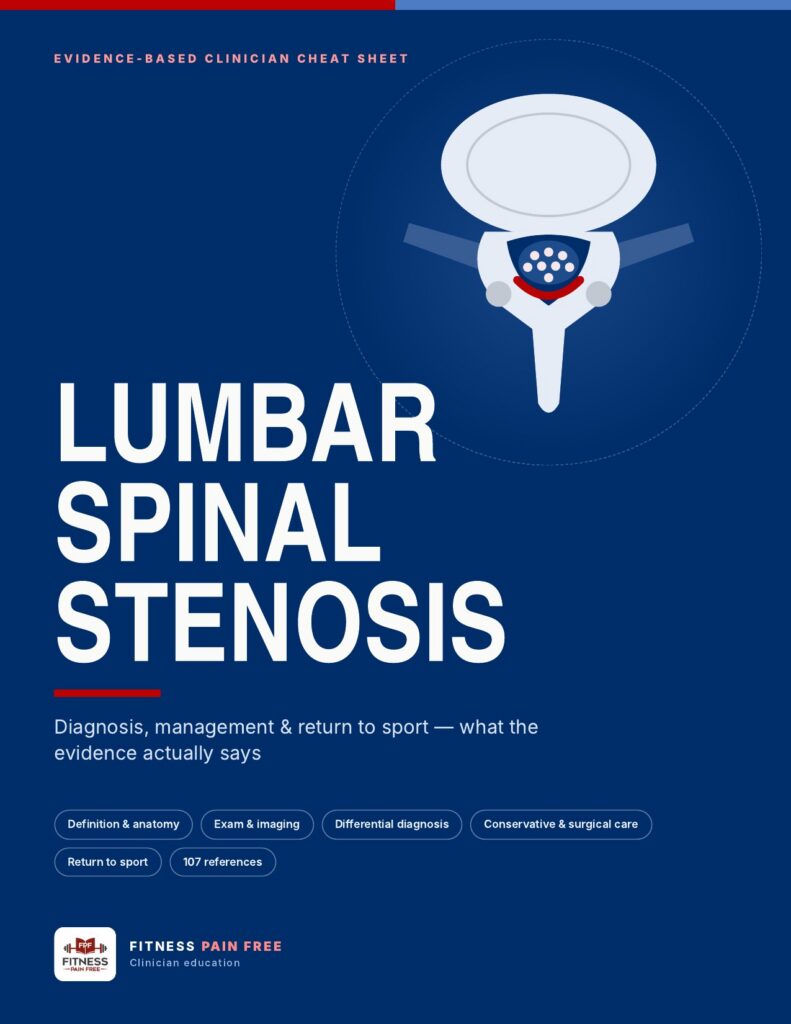
Click HERE to Download FREE
In today’s video we go over how to diagnose lumbar spinal stenosis, a step-by-step guide for physical therapists:
A patient walks in with an MRI report that says “stenosis” and back and leg pain that makes walking miserable. Is stenosis really the problem? Or is it vascular claudication, the hip, the glutes, or a nerve root?
In this video, we break down how to diagnose lumbar spinal stenosis (and neurogenic claudication) using the patient history, the clinical examination and a smart differential diagnosis, with practical physical therapy exam demonstrations you can use in the clinic tomorrow.
What You’ll Learn About Lumbar Spinal Stenosis Diagnosis
- How imaging findings fit into the clinical assessment (and why the MRI alone isn’t the diagnosis)
- Typical patient demographics and subjective complaints
- What standing, walking, sitting and the shopping cart sign tell you
- Five findings in a subjective cluster that can boost your diagnostic confidence
- Gait, balance and the Romberg test
- Range of motion and neurological testing
- How to run the two-stage treadmill test
- Lumbar spinal stenosis differential diagnosis: vascular claudication, hip osteoarthritis, gluteal tendinopathy and radicular pain
Diagnosing Lumbar Spinal Stenosis: Key Points From the Research
- Stenosis is a clinical syndrome, not an MRI finding. Radiological stenosis shows up in about 11% of people with no symptoms at all (Jensen 2020), so the imaging has to match the story and the exam.
- The history does most of the heavy lifting. In an international Delphi study, clinicians reached roughly 80% diagnostic certainty after just six history questions (Tomkins-Lane 2016). Leg or buttock pain with walking, relief with sitting or flexing forward, and age over about 60 are the big ones.
- Watch for posture-dependent symptoms. Neurogenic claudication eases with flexion (leaning on a shopping cart, walking uphill), while vascular claudication is exercise-dependent and eases with rest in any position (Katz 2022).
- No single test rules it in or out. A systematic review of 9 studies (36,228 participants) found the most helpful findings were no pain when seated, perineal numbness, the two-stage treadmill test and an abnormal Romberg, but none were strong enough alone (Cook 2020).
- Know the numbers on your exam findings. Self-reported poor balance: sensitivity ~70%, specificity ~53%. Thigh pain with lumbar extension: sensitivity ~51%, specificity ~69% (Cook 2020). Wide-based gait plus a positive Romberg: sensitivity ~40%, specificity ~90% (Webb 2024).
- Use the treadmill to your advantage. Earlier symptom onset with level walking, longer walking tolerance on an incline and slower recovery after level walking were all associated with stenosis on the two-stage treadmill test (Fritz 1997).
- Always screen the mimics. International consensus recommends a neurological exam, imaging and a walking test, plus checking foot pulses, the hip and the cervical spine to rule out look-alike conditions (Tomkins-Lane 2020).
Our goal? Help you feel more confident evaluating patients with back and leg pain and figuring out whether stenosis is really the driver.
Stop guessing with your lumbar spine patients.
Inside FPF Insiders Academy you get the full Lumbar Radicular Pain Master Course plus 35+ more that take common pathologies from first visit to discharge, 50+ evidence-based cheat sheets, and unlimited CEUs for PTs, PTAs and ATs.
Video Timestamps
- 0:00 Introduction
- 0:57 About Dan Pope
- 1:10 Diagnosis considerations
- 1:38 Patient demographics
- 2:13 Subjective complaints
- 3:00 What hurts?
- 3:14 What helps?
- 3:43 Shopping cart sign
- 4:30 Free spinal stenosis cheat sheet
- 5:06 Subjective cluster
- 5:35 Objective examination and gait
- 6:39 Romberg test
- 7:33 Range of motion testing
- 8:49 Neurological examination
- 9:34 Two-stage treadmill test
- 10:37 Differential diagnosis
- 11:38 Hip osteoarthritis
- 11:59 Gluteal tendinopathy
- 12:17 Radicular pain
Happy diagnosing,
– Dan Pope DPT,OCS,CSCS
Show Notes / Relevant Articles:
- FPF Mini Course – 7 Reasons Why Injuries Happen in the Gym and What to do About it
- Watch Next: Lumbar Radicular Pain Diagnosis (YouTube)
- Radicular Lower Back Pain MASTER CLASS For Physical Therapists [Disc Herniation]
- Dermatome Testing of the Lower Extremity: Peripheral Neurological Examination for Physical Therapists
- Myotome Testing of the Lower Extremity: Peripheral Neurological Examination for Physical Therapists
- Lower Extremity Reflex Testing: Guide for Physical Therapists
- What Physical Therapists NEED to Know About Gluteal Tendinopathy
- Guide to Diagnosing Spondylolysis and Spondylolisthesis for Physical Therapists
- Evidence-Based Manual Therapy Techniques for Low Back Pain
FPF INSIDERS ACADEMY · YOUR FIRST WEEK FOR $1
Become a Confident, Strength-Based Clinician
School taught you rehab, not how to train. Insiders Academy is a guided system for rehab pros who work with active and athletic patients, so you can stop guessing and start practicing with confidence.
- 35+ Master Courses from first visit to discharge (including Lumbar Radicular Pain)
- 50+ cheat sheets to stay current in under 10 minutes
- Unlimited CEUs at no extra cost for PTs, PTAs and ATs
- Real case studies, protocols and a private clinician community
$1 for 7 days, then $25/month · cancel anytime · 7-day money-back guarantee
Looking for other ways to support me that are 100% free?
- Like, comment and share on youtube, facebook and instagram
- Leave a 5-star review on apple podcasts
Thank you!
Dan Pope DPT, OCS, CSCS
References:
- Katz JN, Zimmerman ZE, Mass H, Makhni MC. Diagnosis and Management of Lumbar Spinal Stenosis: A Review. JAMA. 2022 May 3;327(17):1688-1699. doi: 10.1001/jama.2022.5921. PMID: 35503342.
- Walter KL, O’Toole JE. Lumbar Spinal Stenosis. JAMA. 2022 Jul 19;328(3):310. doi: 10.1001/jama.2022.6137. PMID: 35503646.
- Cook CJ, Cook CE, Reiman MP, Joshi AB, Richardson W, Garcia AN. Systematic review of diagnostic accuracy of patient history, clinical findings, and physical tests in the diagnosis of lumbar spinal stenosis. Eur Spine J. 2020 Jan;29(1):93-112. doi: 10.1007/s00586-019-06048-4. Epub 2019 Jul 16. PMID: 31312914.
- Webb CW, Aguirre K, Seidenberg PH. Lumbar Spinal Stenosis: Diagnosis and Management. Am Fam Physician. 2024 Apr;109(4):350-359. PMID: 38648834.
- Jensen RK, Jensen TS, Koes B, Hartvigsen J. Prevalence of lumbar spinal stenosis in general and clinical populations: a systematic review and meta-analysis. Eur Spine J. 2020 Sep;29(9):2143-2163. doi: 10.1007/s00586-020-06339-1. PMID: 32095908.
- Tomkins-Lane C, Melloh M, Lurie J, et al. ISSLS Prize Winner: Consensus on the Clinical Diagnosis of Lumbar Spinal Stenosis: Results of an International Delphi Study. Spine (Phila Pa 1976). 2016 Aug 1;41(15):1239-1246. doi: 10.1097/BRS.0000000000001476. PMID: 26839989.
- Tomkins-Lane C, Melloh M, Wong A. Diagnostic tests in the clinical diagnosis of lumbar spinal stenosis: Consensus and Results of an International Delphi Study. Eur Spine J. 2020 Sep;29(9):2188-2197. doi: 10.1007/s00586-020-06481-w. PMID: 32519030.
- Suri P, Rainville J, Kalichman L, Katz JN. Does this older adult with lower extremity pain have the clinical syndrome of lumbar spinal stenosis? JAMA. 2010 Dec 15;304(23):2628-36. doi: 10.1001/jama.2010.1833. PMID: 21156951.
- Genevay S, Courvoisier DS, Konstantinou K, et al. Clinical classification criteria for neurogenic claudication caused by lumbar spinal stenosis. The N-CLASS criteria. Spine J. 2018 Jun;18(6):941-947. doi: 10.1016/j.spinee.2017.10.003. PMID: 29031994.
- Fritz JM, Erhard RE, Delitto A, Welch WC, Nowakowski PE. Preliminary results of the use of a two-stage treadmill test as a clinical diagnostic tool in the differential diagnosis of lumbar spinal stenosis. J Spinal Disord. 1997 Oct;10(5):410-6. PMID: 9355058.