Sports hernia rehab is tricky because the research is thin, the definitions are messy and almost every study uses a different program. So what did the athletes in the trials actually do, and what can you take straight into the clinic? To go along with today’s video I have a brand new cheat sheet to share…
Sign up to receive FREE: The Athletic Pubalgia (Sports Hernia) Evidence Based Cheat Sheet
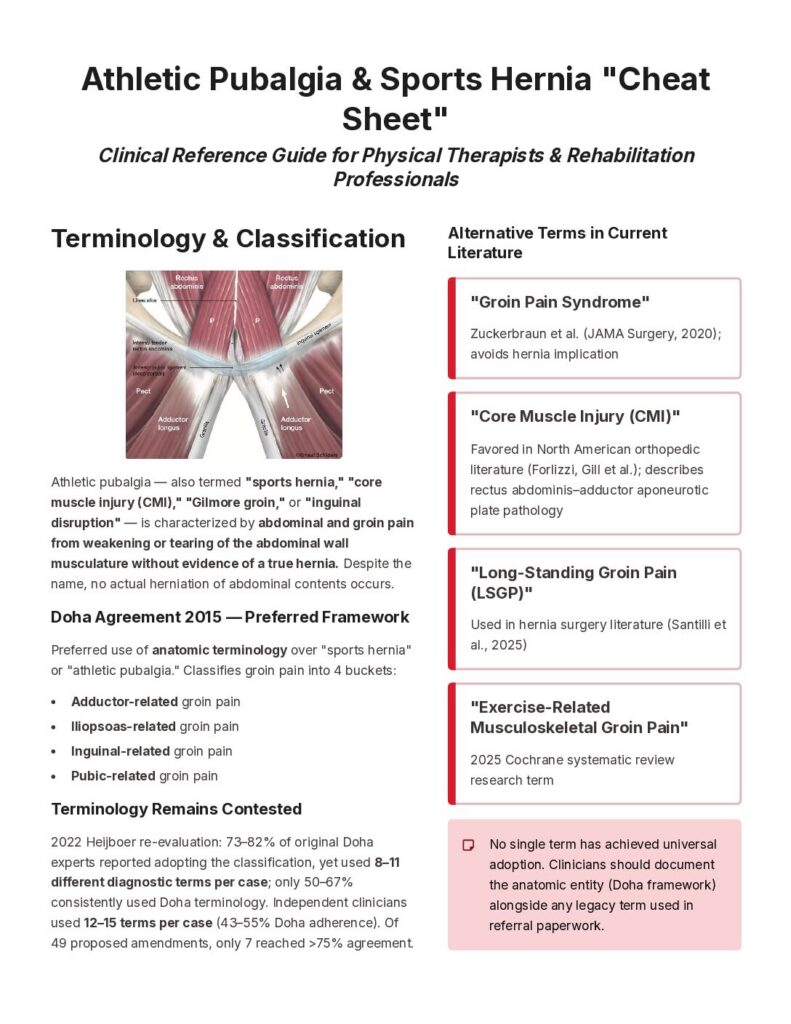
Click HERE to Download FREE
In today’s video I break down the research on athletic pubalgia and related groin pain, then walk through exactly what the published programs had athletes do:
What did the sports hernia rehab studies actually prescribe? I cover the exercises, sets, reps, progression criteria and return-to-sport testing used in the published programs, built for physical therapists and rehab clinicians treating active patients and athletes.
We compare the Hölmich adductor and abdominal strengthening program with the King and Baida intersegmental control approach, go through running, sprinting and cutting progressions, and look at the Abouelnaga program, Eberbach’s staged progression criteria and the Serner return-to-play checkpoints. Keep in mind that most of these studies involve specific groin-pain populations, so their findings don’t apply equally to every core muscle injury or athletic pubalgia presentation. This episode covers the evidence and published protocols. My personal treatment framework will be covered separately.
What You’ll Learn About Sports Hernia Rehab
- Active versus passive care: what the trials found and where the evidence is limited
- Hölmich adductor and abdominal strengthening versus King/Baida intersegmental control
- The exact exercises, sets and reps used in the published programs
- Exercise dosage, running progressions, sprinting and cutting
- The Abouelnaga week-by-week program and Eberbach’s staged progression criteria
- How surgery compares with nonoperative care
- Pain, strength, sport-specific testing and full team training before return to play
Sports Hernia Rehab: Key Points From the Research
- Active beats passive. In athletes with long-standing adductor-related groin pain, 79% (23/29) of the active training group returned to sport pain-free vs 13% (4/30) with passive physical therapy (Hölmich 1999). That’s roughly a 6x higher chance of a pain-free return (Almeida 2013).
- The evidence is thin. Recommendations rest on a handful of RCTs plus observational protocols, and most trials study adductor-related groin pain, which overlaps with but isn’t the same as a true core muscle injury (Almeida 2013).
- Active rehab helps sports hernia too. In 40 soccer players with sports hernia, adding an 8-week active program to passive care meant 13 of 20 returned to sport without groin pain vs 3 of 20 with passive care alone (65% vs 15%), and pain dropped about 80% vs 42% (Abouelnaga 2019).
- Criteria-gated movement control works. A three-level intersegmental control program got 73% of 205 athletes back to play pain-free at a mean of 9.9 ± 3.5 weeks (King 2018).
- Strength isn’t the whole story. Hip muscle strength explained only about 11% of the improvement in HAGOS scores with the intersegmental approach (Baida 2021). That doesn’t mean adductor loading is unnecessary: it was a single-arm cohort, and squats, lunges and cutting still load the adductors.
- Surgery vs nonoperative care. In 60 athletes with chronic groin pain, 90% returned to sport at 3 months after laparoscopic mesh repair vs 27% with nonoperative treatment (Paajanen 2011). Chronic cases that don’t respond to active rehab may need a surgical consult.
- Progress on tests, not just time. Eberbach’s six-level program blended Copenhagen adductor loading with staged running, and athletes moved up only after passing each level’s test with pain at or below 3/10 (Eberbach 2021).
- Return to play rests on three pillars. Pain-free adduction and field tasks, restored adduction strength, and pain-free full-speed sprinting, agility and sport skills (Pecci 2026), finishing with a full team training session without symptoms (Serner 2020).
Our goal? Help you build a sports hernia rehab plan that’s grounded in what the research actually did, so you can load your athletes with confidence and get them back to play.
Stop guessing on groin pain.
Inside FPF Insiders Academy you get 35+ Master Courses that take common pathologies from first visit to discharge (including Athletic Pubalgia and Adductor Strains), 50+ evidence-based cheat sheets (including Athletic Pubalgia), live member case breakdowns, and unlimited CEUs for PTs, PTAs and ATs.
Video Timestamps
- 0:00 Sports hernia rehab: what does the research show?
- 1:24 Active rehab versus passive treatment
- 2:37 Landmark trials and return-to-sport results
- 3:21 Research outcomes
- 5:17 Active rehabilitation
- 5:31 Common findings and limitations
- 7:19 What the trials prescribed
- 9:03 Hölmich: initial loading
- 10:09 Hölmich: dynamic loading and return to sport
- 11:48 King and Baida: criteria and outcomes
- 13:30 King and Baida: exercise progression
- 16:53 Running and cutting progressions
- 21:34 Adductor loading and interpretation
- 23:58 Other trials and surgery comparison
- 29:50 Abouelnaga: week-by-week program
- 30:34 Eberbach: criteria for progression
- 32:00 Return-to-play evidence
- 34:13 Serner: checkpoints and team training
- 35:55 Practical return-to-play checklist
- 37:42 Watch next: favorite adductor exercises
Happy rehabbing,
– Dan Pope DPT,OCS,CSCS
Show Notes / Relevant Articles:
- FPF Mini Course – 7 Reasons Why Injuries Happen in the Gym and What to do About it
- Watch Next: My FAVORITE Hip Adductor Exercises for Physical Therapists (YouTube)
- Sports Hernia Explained: Diagnosis, Special Tests & Differential Diagnosis
- Sports Hernia Diagnosis: The Tests Every Clinician Should Know
- Adductor Strain Rehab: Evidence-Based Treatment, Exercises & Return to Sport
- Adductor Strains: What Physical Therapists Need to Know
- How to Diagnose Adductor Strains (Without Guessing)
- The Best Adductor Exercises: New Study Ranks Them by Muscle Force
- My FAVORITE Hip Adductor Exercises for Physical Therapists
- A Step-by-Step System for Anterior Core Training (From Beginner to Advanced)
- Lateral Core Training for Physical Therapists (The COMPLETE Guide)
FPF INSIDERS ACADEMY · YOUR FIRST WEEK FOR $1
Become a Confident, Strength-Based Clinician
School taught you rehab, not how to train. Insiders Academy is a guided system for rehab pros who work with active and athletic patients, so you can stop guessing and start practicing with confidence.
- 35+ Master Courses from first visit to discharge
- 50+ cheat sheets to stay current in under 10 minutes (including Athletic Pubalgia)
- Unlimited CEUs at no extra cost for PTs, PTAs and ATs
- Real case studies, protocols and a private clinician community
$1 for 7 days, then $25/month · cancel anytime · 7-day money-back guarantee
Looking for other ways to support me that are 100% free?
- Like, comment and share on youtube, facebook and instagram
- Leave a 5-star review on apple podcasts
Thank you!
Dan Pope DPT, OCS, CSCS
References:
- Hölmich P, Uhrskou P, Ulnits L, Kanstrup IL, Nielsen MB, Bjerg AM, Krogsgaard K. Effectiveness of active physical training as treatment for long-standing adductor-related groin pain in athletes: randomised trial. Lancet. 1999 Feb 6;353(9151):439-43. doi: 10.1016/S0140-6736(98)03340-6. PMID: 9989713.
- Almeida MO, Silva BN, Andriolo RB, Atallah AN, Peccin MS. Conservative interventions for treating exercise-related musculotendinous, ligamentous and osseous groin pain. Cochrane Database Syst Rev. 2013 Jun 6;2013(6):CD009565. doi: 10.1002/14651858.CD009565.pub2. PMID: 23740671; PMCID: PMC9719104.
- Abouelnaga WA, Aboelnour NH. Effectiveness of Active Rehabilitation Program on Sports Hernia: Randomized Control Trial. Ann Rehabil Med. 2019 Jun;43(3):305-313. doi: 10.5535/arm.2019.43.3.305. Epub 2019 Jun 28. PMID: 31311252; PMCID: PMC6637051.
- King E, Franklyn-Miller A, Richter C, O’Reilly E, Doolan M, Moran K, Strike S, Falvey É. Clinical and biomechanical outcomes of rehabilitation targeting intersegmental control in athletic groin pain: prospective cohort of 205 patients. Br J Sports Med. 2018 Aug;52(16):1054-1062. doi: 10.1136/bjsports-2016-097089. Epub 2018 Mar 17. PMID: 29550754; PMCID: PMC6089205.
- Baida SR, King E, Richter C, Gore S, Franklyn-Miller A, Moran K. Hip Muscle Strength Explains Only 11% of the Improvement in HAGOS With an Intersegmental Approach to Successful Rehabilitation of Athletic Groin Pain. Am J Sports Med. 2021 Sep;49(11):2994-3003. doi: 10.1177/03635465211028981. Epub 2021 Aug 16. PMID: 34398640; PMCID: PMC8411474.
- Eberbach H, Fürst-Meroth D, Kloos F, Leible M, Bohsung V, Bode L, Wenning M, Hagen S, Bode G. Long-standing pubic-related groin pain in professional academy soccer players: a prospective cohort study on possible risk factors, rehabilitation and return to play. BMC Musculoskelet Disord. 2021 Nov 17;22(1):958. doi: 10.1186/s12891-021-04837-x. PMID: 34789227; PMCID: PMC8600924.
- Paajanen H, Brinck T, Hermunen H, Airo I. Laparoscopic surgery for chronic groin pain in athletes is more effective than nonoperative treatment: a randomized clinical trial with magnetic resonance imaging of 60 patients with sportsman’s hernia (athletic pubalgia). Surgery. 2011 Jul;150(1):99-107. doi: 10.1016/j.surg.2011.02.016. Epub 2011 May 5. PMID: 21549403.
- Elgohary HM, Abdelrahim AA, Ali ZMI, Ali OI, Ahmed AA. Does Adding a Pilates Exercise Program Enhance Recovery Outcomes for Sports Hernia? A Randomized Controlled Trial. J Integr Complement Med. 2026 Jul;32(7):573-582. doi: 10.1177/27683605251411152. Epub 2026 Mar 30. PMID: 41912373.
- Pecci J, van Dyk N, Myer GD, Sañudo B. Return-to-Play Criteria Following Lower Limb Muscle Injuries in Soccer: A Systematic Review with Evidence Synthesis. Sports Med. 2026 Jun;56(6):1433-1465. doi: 10.1007/s40279-026-02404-9. Epub 2026 Mar 18. PMID: 41851593; PMCID: PMC13260053.
- Serner A, Weir A, Tol JL, Thorborg K, Lanzinger S, Otten R, Hölmich P. Return to Sport After Criteria-Based Rehabilitation of Acute Adductor Injuries in Male Athletes: A Prospective Cohort Study. Orthop J Sports Med. 2020 Jan 29;8(1):2325967119897247. doi: 10.1177/2325967119897247. PMID: 32064292; PMCID: PMC6990618.
- Serner A, Weir A, Tol JL, Thorborg K, Yamashiro E, Guermazi A, Roemer FW, Hölmich P. Associations Between Initial Clinical Examination and Imaging Findings and Return-to-Sport in Male Athletes With Acute Adductor Injuries: A Prospective Cohort Study. Am J Sports Med. 2020 Apr;48(5):1151-1159. doi: 10.1177/0363546520908610. Epub 2020 Mar 17. PMID: 32182099.
- Siqueira APP, Hespanhol L, Oliveira AJ, Andriolo B, Andriolo RB, Atallah ÁN, Peccin MS, Almeida MO. Conservative interventions for managing exercise-related musculoskeletal groin pain. Cochrane Database Syst Rev. 2025 Sep 25;9(9):CD016137. doi: 10.1002/14651858.CD016137. PMID: 40995847; PMCID: PMC12461783.