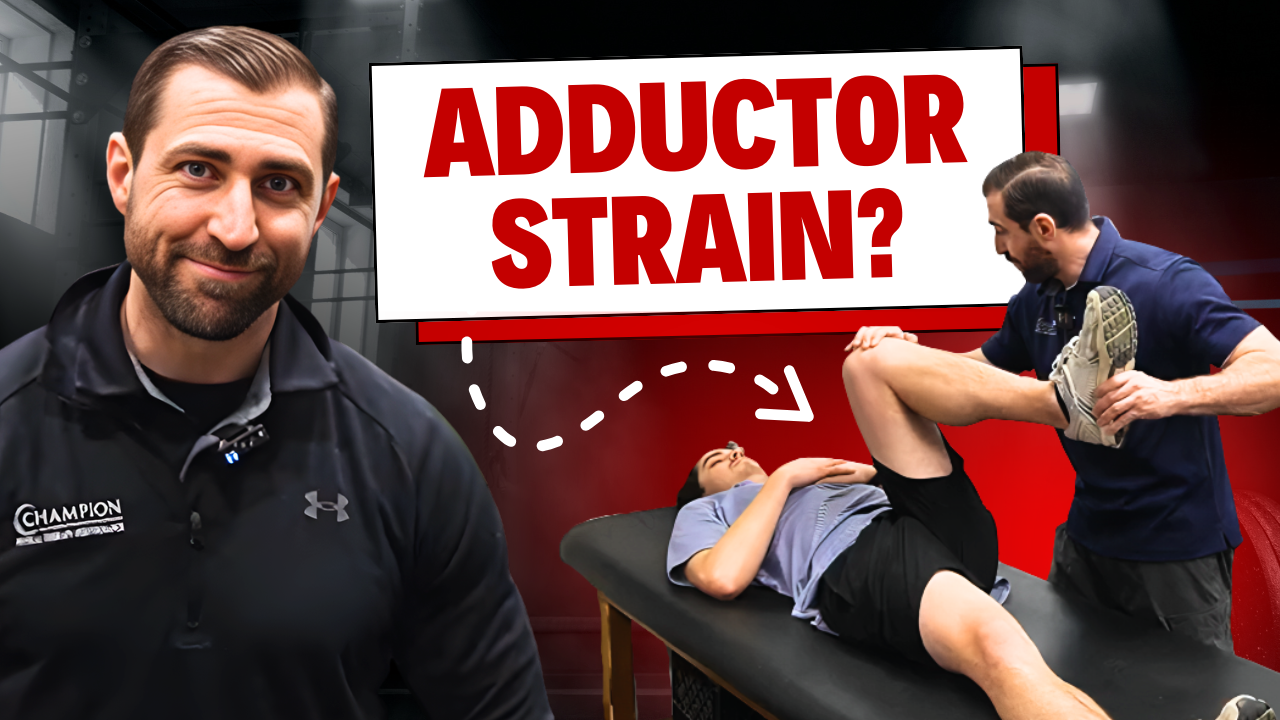
How to Diagnose Adductor Strains (Without Guessing)
To go along with today's episode I have a nice infographic to share...
Sign up to receive FREE: Adductor Strain - The Evidence Based Cheat Sheet
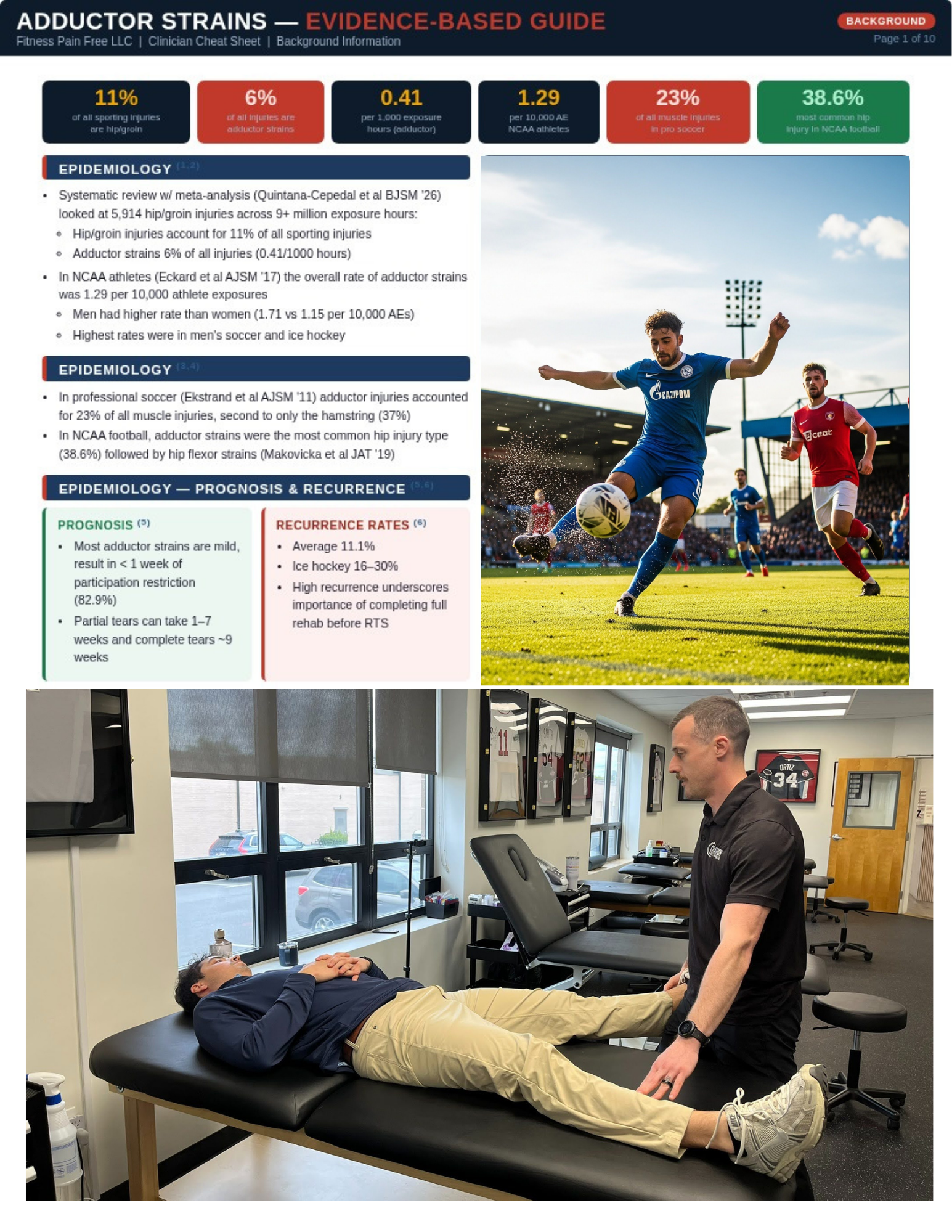
Click HERE to Download FREE
Grab the rest of the Mini Course and Sign up for the Certification Pre-sale list:
- FPF Mini Course - 7 Reasons Why Injuries Happen in the Gym and What to do About it
- The Fitness Pain Free Certification
In today's video we go over How to Diagnose Adductor Strains (Without Guessing):
Groin pain in athletes can be incredibly sneaky and tricky to manage. As a sports physical therapist or strength coach, you know that 1 in 5 athletes will suffer from a new adductor strain over a single season — especially in high-demand sports like soccer, hockey, and football.
But while basic adductor pain seems straightforward, missing a critical red flag can completely derail an athlete's recovery and push back their return-to-sport timeline. How do you confidently differentiate a standard adductor longus strain from FAI (Femoroacetabular Impingement), a true hernia, or athletic pubalgia (core muscle injury)?
In this video, we'll break down the exact subjective clues, objective special tests, and clinical pearls you need to accurately diagnose adductor strains in under 10 minutes—ensuring you never miss a complete avulsion or a hidden hip joint pathology.
What We Cover In-Depth:
 The 91% Rule: Why the adductor longus is almost always the culprit, and how to isolate it during palpation.
Objective Special Tests: Step-by-step demonstrations of the Squeeze Test, Resisted Outer Range Adduction, and Passive Adductor Stretch.
Clearing the Hip Joint: How to use the FADIR and FABER tests to rule out Femoroacetabular Impingement (FAI), hip osteoarthritis, or dysplasia.
Spotting Red Flags: How to differentiate an acute strain from a true hernia or gradual-onset athletic pubalgia (core muscle injury) so you know exactly when to refer back to a physician.
TIMELINE
- 00:00 – Why Sports Physical Therapists Struggle with Groin Injuries
- 01:04 – Most Common Athlete Populations & Mechanisms of Injury
- 01:44 – Subjective Assessment: Kicking, Cutting & Tearing Sensations
- 02:32 – How to Palpate the Adductor Longus (90%+ of Groin Strains)
- 03:26 – Red Flags: Bruising, Palpable Defects, and Complete Avulsions
- 04:04 – The Squeeze Test & Resisted Outer Range Adduction Test
- 04:50 – Passive Adductor Stretch Test Explained
- 05:01 – Differential Diagnosis: Ruling Out FAI (FADIR & FABER Tests)
- 05:48 – How to Screen for True Hernias vs. Groin Strains
- 06:13 – Athletic Pubalgia & Core Muscle Injury Assessment
Diagnosis, Groin Pull!
- Dan Pope DPT,OCS,CSCS
Show Notes / Relevant Articles:

Want to support me and decide topics for future episodes? Click HERE to sign up for FPF "Insiders" for just a dollar. You'll gain access to 100+ webinars, e-books and complete guides. Plus, you'll get private access to the "Insiders" Facebook group where you can have all of your questions answered by me.
Looking for other ways to support me that are 100% free?
- Like, comment and share on youtube, facebook and instagram
- Leave a 5-star review on apple podcasts
Thank you!
Dan Pope DPT, OCS, CSCS
References:
Quintana-Cepedal M, Maniar N, Del Valle Soto M, Crespo I, Olmedillas H. Epidemiology of hip and groin injuries in sport: a systematic review with meta-analysis and meta-regression of 5914 injuries from over 9 million exposure hours. Br J Sports Med. 2026 Mar 23;60(7):543-551. doi: 10.1136/bjsports-2024-109441. PMID: 41565445.
Eckard TG, Padua DA, Dompier TP, Dalton SL, Thorborg K, Kerr ZY. Epidemiology of Hip Flexor and Hip Adductor Strains in National Collegiate Athletic Association Athletes, 2009/2010-2014/2015. Am J Sports Med. 2017 Oct;45(12):2713-2722. doi: 10.1177/0363546517716179. Epub 2017 Jul 26. PMID: 28745561.
Ekstrand J, Hägglund M, Waldén M. Epidemiology of muscle injuries in professional football (soccer). Am J Sports Med. 2011 Jun;39(6):1226-32. doi: 10.1177/0363546510395879. Epub 2011 Feb 18. PMID: 21335353.
Makovicka JL, Chhabra A, Patel KA, Tummala SV, Hartigan DE. A Decade of Hip Injuries in National Collegiate Athletic Association Football Players: An Epidemiologic Study Using National Collegiate Athletic Association Surveillance Data. J Athl Train. 2019 May;54(5):483-488. doi: 10.4085/1062-6050-59-18. Epub 2019 May 14. PMID: 31084503; PMCID: PMC6602372.
Farrell SG, Hatem M, Bharam S. Acute Adductor Muscle Injury: A Systematic Review on Diagnostic Imaging, Treatment, and Prevention. Am J Sports Med. 2023 Nov;51(13):3591-3603. doi: 10.1177/03635465221140923. Epub 2023 Jan 20. PMID: 36661128.
Eckard TG, Padua DA, Dompier TP, Dalton SL, Thorborg K, Kerr ZY. Epidemiology of Hip Flexor and Hip Adductor Strains in National Collegiate Athletic Association Athletes, 2009/2010-2014/2015. Am J Sports Med. 2017 Oct;45(12):2713-2722. doi: 10.1177/0363546517716179. Epub 2017 Jul 26. PMID: 28745561.
Nicholas SJ, Tyler TF. Adductor muscle strains in sport. Sports Med. 2002;32(5):339-44. doi: 10.2165/00007256-200232050-00005. PMID: 11929360.
Serner A, Tol JL, Jomaah N, Weir A, Whiteley R, Thorborg K, Robinson M, Hölmich P. Diagnosis of Acute Groin Injuries: A Prospective Study of 110 Athletes. Am J Sports Med. 2015 Aug;43(8):1857-64. doi: 10.1177/0363546515585123. Epub 2015 May 14. PMID: 25977522.
Zuckerbraun BS, Cyr AR, Mauro CS. Groin Pain Syndrome Known as Sports Hernia: A Review. JAMA Surg. 2020;155(4):340–348. doi:10.1001/jamasurg.2019.5863
Almeida MO, Silva BNG, Andriolo RB, Atallah ÁN, Peccin MS. Conservative interventions for treating exercise‐related musculotendinous, ligamentous and osseous groin pain. Cochrane Database of Systematic Serner A, Weir A, Tol JL, Thorborg K, Roemer F, Guermazi A, Hölmich P. Can standardised clinical examination of athletes with acute groin injuries predict the presence and location of MRI findings? Br J Sports Med. 2016 Dec;50(24):1541-1547. doi: 10.1136/bjsports-2016-096290. Epub 2016 Aug 16. PMID: 27531521.
Weir A, Brukner P, Delahunt E, Ekstrand J, Griffin D, Khan KM, Lovell G, Meyers WC, Muschaweck U, Orchard J, Paajanen H, Philippon M, Reboul G, Robinson P, Schache AG, Schilders E, Serner A, Silvers H, Thorborg K, Tyler T, Verrall G, de Vos RJ, Vuckovic Z, Hölmich P. Doha agreement meeting on terminology and definitions in groin pain in athletes. Br J Sports Med. 2015 Jun;49(12):768-74. doi: 10.1136/bjsports-2015-094869. PMID: 26031643; PMCID: PMC4484366