To go along with today’s episode I have a nice infographic to share…
Sign up to receive FREE: Athletic Pubalgia (Sports Hernia) – The Evidence Based Cheat Sheet
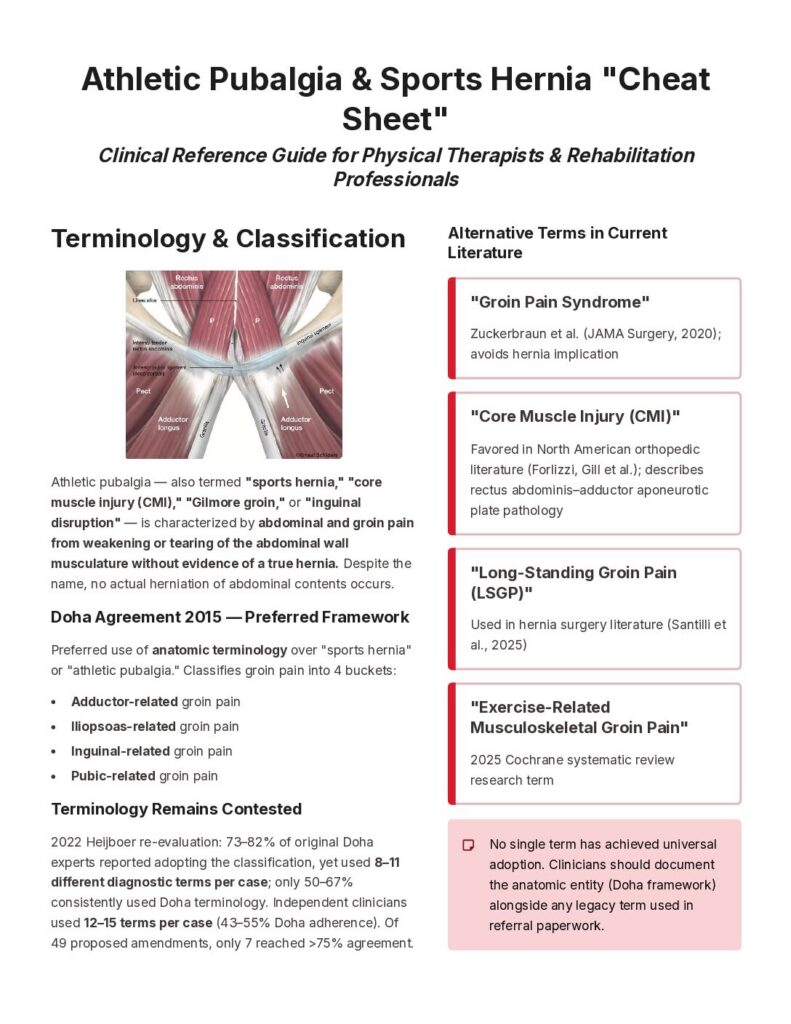
Click HERE to Download FREE
In today’s video we go over Sports Hernia Explained: Diagnosis, Special Tests & Differential Diagnosis:
Sports hernia, athletic pubalgia, core muscle injury, Gilmore’s groin… whatever you call it, diagnosing groin pain in athletes can be incredibly challenging.
In this video, we break down the latest evidence on sports hernia / athletic pubalgia diagnosis, including clinical presentation, subjective examination, special tests, differential diagnosis, imaging findings, and the relationship between femoroacetabular impingement (FAI) and chronic groin pain.
We’ll cover:
- The Doha Agreement and why the terminology is so confusing
- Adductor-related, iliopsoas-related, inguinal-related and pubic-related groin pain
- Who is most at risk (and how common groin injuries really are)
- The anatomy every clinician should understand around the pubic symphysis
- Why MRI findings can mislead you
- Why multiple groin diagnoses often coexist, and the HUGE connection between FAI and sports hernia
- The subjective exam, physical exam and special tests
- Imaging and diagnostic injections
- Conservative treatment, injections, and when surgery should be considered
- Return-to-sport rates after surgery
A few key points from the research:
- Use the Doha categories. The 2015 Doha Agreement sorts groin pain into adductor-related, iliopsoas-related, inguinal-related and pubic-related. “Sports hernia” mostly maps to inguinal-related groin pain, and there is no true hernia.
- Expect more than one diagnosis. In 100 athletes with groin pain, 44% had more than one clinical entity, and adductor-related pain was the most common (Taylor 2018).
- Don’t diagnose off the MRI. Bone marrow edema, adductor tendinopathy and degenerative changes are very common in asymptomatic soccer players. Groin pain remains a clinical diagnosis.
- Always check the hip. 86% of athletes undergoing athletic pubalgia surgery had radiographic signs of FAI (Economopoulos 2014), and untreated FAI is a recognized cause of surgical failure.
- Know your special tests. The resisted cross-body sit-up was very sensitive (100%) but not specific (3%), and the external rotation Stinchfield test had the highest specificity at 60% (Kurowicki 2020).
- Surgery has a role. In the only RCT, 90% of surgical patients returned to sport at 3 months vs 27% with conservative care (Paajanen 2011). Typical return to play is about 4 weeks after isolated repair and 8–12 weeks when adductor release is added.
Our goal? Help you become more confident evaluating athletes with persistent groin pain and making better clinical decisions.
Want to earn CEUs while learning this material?
This type of content is also available inside Fitness Pain Free Insiders Academy, where you can take evidence-based continuing education courses designed specifically for rehab and fitness professionals—and earn CEUs while you learn.
Join FPF Insiders Academy + Earn CEUs: 👉 CLICK HERE
TIMESTAMPS
- 0:00 Sports Hernia: What Physical Therapists Need to Know
- 1:43 The Doha Agreement & Why the Diagnosis Is So Confusing
- 2:32 Adductor-Related Groin Pain
- 4:49 Iliopsoas-Related Groin Pain
- 5:49 Inguinal-Related Groin Pain
- 9:00 Pubic-Related Groin Pain
- 16:18 How Common Is Sports Hernia & Groin Pain?
- 18:37 Which Athletes Are Most at Risk?
- 21:52 Anatomy Every Clinician Should Understand
- 23:46 The Problem With MRI Findings
- 27:16 Risk Factors for Athletic Pubalgia
- 35:29 Why Multiple Groin Diagnoses Often Coexist
- 36:32 The HUGE Connection Between FAI & Sports Hernia
- 40:02 How Sports Hernias Develop
- 46:04 Subjective Exam & Clinical Presentation
- 52:05 Physical Exam & Special Tests
- 54:37 Imaging & Diagnostic Injections
- 1:01:20 Differential Diagnosis of Groin Pain
- 1:04:01 Conservative Treatment & Physical Therapy
- 1:06:26 Shockwave, Cortisone, PRP & Other Treatments
- 1:13:07 When Should Surgery Be Considered?
- 1:17:26 Return-to-Sport Rates After Surgery
- 1:21:51 Surgical Takeaways for Rehab Professionals
Super groins,
– Dan Pope DPT,OCS,CSCS
Show Notes / Relevant Articles:
- FPF Mini Course – 7 Reasons Why Injuries Happen in the Gym and What to do About it
- Sports Hernia Diagnosis: The Tests Every Clinician Should Know
- Adductor Strains: What Physical Therapists Need to Know
- How to Diagnose Adductor Strains (Without Guessing)
- Adductor Strain Rehab: Evidence-Based Treatment, Exercises & Return to Sport
- Diagnose Femoral Acetabular Impingement Syndrome ACCURATELY [Physical Therapist’s Guide]
- The Best Diagnostic Tests for Hip Flexor Strain Injuries
- A Step-by-Step System for Anterior Core Training (From Beginner to Advanced)
Looking for other ways to support me that are 100% free?
- Like, comment and share on youtube, facebook and instagram
- Leave a 5-star review on apple podcasts
Thank you!
Dan Pope DPT, OCS, CSCS
References:
- Drager J, Rasio J, Newhouse A. Athletic Pubalgia (Sports Hernia): Presentation and Treatment. Arthroscopy. 2020 Dec;36(12):2952-2953. doi: 10.1016/j.arthro.2020.09.022. PMID: 33276883.
- Zuckerbraun BS, Cyr AR, Mauro CS. Groin Pain Syndrome Known as Sports Hernia: A Review. JAMA Surg. 2020 Apr 1;155(4):340-348. doi: 10.1001/jamasurg.2019.5863. PMID: 32022837.
- Herring SA, Kibler WB, Putukian M, Boyajian-O’Neill LA, Chang CJ, Franks RR, Hutchinson M, Indelicato PA, O’Connor FG, Powell A, Roach R, Safran M, Statuta SM, Sutton K. Initial Assessment and Management of Select Musculoskeletal Injuries: A Team Physician Consensus Statement. Med Sci Sports Exerc. 2024 Mar 1;56(3):385-401. doi: 10.1249/MSS.0000000000003324. Epub 2023 Oct 16. PMID: 37847756.
- Siqueira APP, Hespanhol L, Oliveira AJ, Andriolo B, Andriolo RB, Atallah ÁN, Peccin MS, Almeida MO. Conservative interventions for managing exercise-related musculoskeletal groin pain. Cochrane Database Syst Rev. 2025 Sep 25;9(9):CD016137. doi: 10.1002/14651858.CD016137. PMID: 40995847; PMCID: PMC12461783.
- Quintana-Cepedal M, Maniar N, Del Valle Soto M, Crespo I, Olmedillas H. Epidemiology of hip and groin injuries in sport: a systematic review with meta-analysis and meta-regression of 5914 injuries from over 9 million exposure hours. Br J Sports Med. 2026 Mar 23;60(7):543-551. doi: 10.1136/bjsports-2024-109441. PMID: 41565445.
- Elattar O, Choi HR, Dills VD, Busconi B. Groin Injuries (Athletic Pubalgia) and Return to Play. Sports Health. 2016 Jul;8(4):313-23. doi: 10.1177/1941738116653711. Epub 2016 Jun 14. PMID: 27302153; PMCID: PMC4922526.
- Orchard JW. Men at higher risk of groin injuries in elite team sports: a systematic review. Br J Sports Med. 2015 Jun;49(12):798-802. doi: 10.1136/bjsports-2014-094272. PMID: 26031645.
- Le CB, Zadeh J, Ben-David K. Total extraperitoneal laparoscopic inguinal hernia repair with adductor tenotomy: a 10-year experience in the treatment of athletic pubalgia. Surg Endosc. 2021 Jun;35(6):2743-2749. doi: 10.1007/s00464-020-07705-2. Epub 2020 Jun 16. PMID: 32556756.
- Rezaie N, Ithurburn MP, Powell MT, Mussell EA, Kidwell-Chandler AL, Emblom BA. Outcomes and Proportions of Subsequent Contralateral Sports Hernia Repair Following Primary Unilateral Repair. Am J Sports Med. 2024 Mar;52(3):653-659. doi: 10.1177/03635465231221496. Epub 2024 Jan 29. PMID: 38284216.
- Matsuda DK. Editorial Commentary: Managing Hip Pain, Athletic Pubalgia, Sports Hernia, Core Muscle Injury, and Inguinal Disruption Requires Diagnostic and Therapeutic Expertise. Arthroscopy. 2021 Jul;37(7):2391-2392. doi: 10.1016/j.arthro.2021.04.027. PMID: 34226017.
- Birmingham PM, Kelly BT, Jacobs R, McGrady L, Wang M. The effect of dynamic femoroacetabular impingement on pubic symphysis motion: a cadaveric study. Am J Sports Med. 2012 May;40(5):1113-8. doi: 10.1177/0363546512437723. Epub 2012 Mar 5. PMID: 22392561.
- Varada S, Moy MP, Wu F, Rasiej MJ, Jaramillo D, Wong TT. The prevalence of athletic pubalgia imaging findings on MRI in patients with femoroacetabular impingement. Skeletal Radiol. 2020 Aug;49(8):1249-1258. doi: 10.1007/s00256-020-03405-z. Epub 2020 Mar 6. PMID: 32144449.
- Kurowicki J, Kraeutler MJ, Dávila Castrodad IM, Hahn AK, Simone ES, Kelly MA, Talishinskiy T, Scillia AJ. Diagnostic Accuracy of Physical Examination Tests in Core Muscle Injury. Am J Sports Med. 2020 Jul;48(8):1983-1988. doi: 10.1177/0363546520926029. Epub 2020 Jun 8. PMID: 32510969.
- Forlizzi JM, Ward MB, Whalen J, Wuerz TH, Gill TJ 4th. Core Muscle Injury: Evaluation and Treatment in the Athlete. Am J Sports Med. 2023 Mar;51(4):1087-1095. doi: 10.1177/03635465211063890. Epub 2022 Mar 2. PMID: 35234538.
- Maloy W, Merrigan B, Hulsopple CD. Groin Pain and Injuries: Evaluation and Management. Am Fam Physician. 2025 Apr;111(4):337-343. PMID: 40238976.
- Paajanen H, Brinck T, Hermunen H, Airo I. Laparoscopic surgery for chronic groin pain in athletes is more effective than nonoperative treatment: a randomized clinical trial with magnetic resonance imaging of 60 patients with sportsman’s hernia (athletic pubalgia). Surgery. 2011 Jul;150(1):99-107. doi: 10.1016/j.surg.2011.02.016. Epub 2011 May 5. PMID: 21549403.
- Kraeutler MJ, Mei-Dan O, Belk JW, Larson CM, Talishinskiy T, Scillia AJ. A Systematic Review Shows High Variation in Terminology, Surgical Techniques, Preoperative Diagnostic Measures, and Geographic Differences in the Treatment of Athletic Pubalgia/Sports Hernia/Core Muscle Injury/Inguinal Disruption. Arthroscopy. 2021 Jul;37(7):2377-2390.e2. doi: 10.1016/j.arthro.2021.03.049. Epub 2021 Apr 9. PMID: 33845134.
- Kopelman D, Kaplan U, Hatoum OA, Abaya N, Karni D, Berber A, Sharon P, Peskin B. The management of sportsman’s groin hernia in professional and amateur soccer players: a revised concept. Hernia. 2016 Feb;20(1):69-75. doi: 10.1007/s10029-014-1322-9. Epub 2014 Nov 8. PMID: 25380561.
- Dudai M, Ganiem M, Meruham R. Endoscopic Totally Extraperitoneal Release and Reinforce (TEP-RRT) With Structured Rehabilitation Program for Sportsman’s Hernia and Athletic Pubalgia: Surgical Technique and 9-Year Clinical Series of 461 Athletes. Surg Laparosc Endosc Percutan Tech. 2026 Apr 1;36(2). doi: 10.1097/SLE.0000000000001432. PMID: 41556420.
- Pilkington JJ, Obeidallah R, Baltatzis M, Fullwood C, Jamdar S, Sheen AJ. Totally extraperitoneal repair for the ‘sportsman’s groin’ via ‘the Manchester Groin Repair’: a comparison of elite versus amateur athletes. Surg Endosc. 2021 Aug;35(8):4371-4379. doi: 10.1007/s00464-020-07930-9. Epub 2020 Sep 9. PMID: 32909207.
- Sheen AJ, Montgomery A, Simon T, Ilves I, Paajanen H. Randomized clinical trial of open suture repair versus totally extraperitoneal repair for treatment of sportsman’s hernia. Br J Surg. 2019 Jun;106(7):837-844. doi: 10.1002/bjs.11226. PMID: 31162653.
- Kajetanek C, Benoît O, Granger B, Menegaux F, Chereau N, Pascal-Mousselard H, Khiami F. Athletic pubalgia: Return to play after targeted surgery. Orthop Traumatol Surg Res. 2018 Jun;104(4):469-472. doi: 10.1016/j.otsr.2018.01.012. Epub 2018 Mar 13. PMID: 29549038.
- Pedrinelli A, de Castro Fernandes JV, Dorilêo Leite Filho CG, Marques de Almeida A, Lazzaretti Fernandes T, Hernandez AJ. Optimised return to play: high treatment success rate in core muscle injury with surgical release of the anterior tendon of the rectus abdominis muscle and proximal tenotomy of the adductor longus muscle. J ISAKOS. 2024 Feb;9(1):16-24. doi: 10.1016/j.jisako.2023.10.013. Epub 2023 Nov 4. PMID: 37931748.
- Economopoulos KJ, Milewski MD, Hanks JB, Hart JM, Diduch DR. Radiographic evidence of femoroacetabular impingement in athletes with athletic pubalgia. Sports Health. 2014 Mar;6(2):171-7. doi: 10.1177/1941738113510857. PMID: 24587869; PMCID: PMC3931339.
- Hammoud S, Bedi A, Magennis E, Meyers WC, Kelly BT. High incidence of athletic pubalgia symptoms in professional athletes with symptomatic femoroacetabular impingement. Arthroscopy. 2012 Oct;28(10):1388-95. doi: 10.1016/j.arthro.2012.02.024. Epub 2012 May 19. PMID: 22608890.
- Naal FD, Dalla Riva F, Wuerz TH, Dubs B, Leunig M. Sonographic prevalence of groin hernias and adductor tendinopathy in patients with femoroacetabular impingement. Am J Sports Med. 2015 Sep;43(9):2146-51. doi: 10.1177/0363546515591259. Epub 2015 Jul 17. PMID: 26187131.
- Weir A, Brukner P, Delahunt E, Ekstrand J, Griffin D, Khan KM, Lovell G, Meyers WC, Muschaweck U, Orchard J, Paajanen H, Philippon M, Reboul G, Robinson P, Schache AG, Schilders E, Serner A, Silvers H, Thorborg K, Tyler T, Verrall G, de Vos RJ, Vuckovic Z, Hölmich P. Doha agreement meeting on terminology and definitions in groin pain in athletes. Br J Sports Med. 2015 Jun;49(12):768-74. doi: 10.1136/bjsports-2015-094869. PMID: 26031643; PMCID: PMC4484366.
- Heijboer WMP, Weir A, Delahunt E, Hölmich P, Schache AG, Tol JL, de Vos RJ, Vuckovic Z, Serner A. A Delphi survey and international e-survey evaluating the Doha agreement meeting classification system in groin pain: Where are we 5 years later? J Sci Med Sport. 2022 Jan;25(1):3-8. doi: 10.1016/j.jsams.2021.06.014. Epub 2021 Jul 6. PMID: 34312067.
- Taylor R, Vuckovic Z, Mosler A, Agricola R, Otten R, Jacobsen P, Holmich P, Weir A. Multidisciplinary Assessment of 100 Athletes With Groin Pain Using the Doha Agreement: High Prevalence of Adductor-Related Groin Pain in Conjunction With Multiple Causes. Clin J Sport Med. 2018 Jul;28(4):364-369. doi: 10.1097/JSM.0000000000000469. PMID: 28654441.
- Branci S, Thorborg K, Bech BH, Boesen M, Nielsen MB, Hölmich P. MRI findings in soccer players with long-standing adductor-related groin pain and asymptomatic controls. Br J Sports Med. 2015 May;49(10):681-91. doi: 10.1136/bjsports-2014-093710. Epub 2014 Dec 15. PMID: 25512059.
- Bezuglov E, Izmailov S, Grinchenko A, Emanov A, Shoshorina M, Malyakin G, Telyshev D, Lyubushkina A, Lazarev A, Morgans R. Prevalence of Asymptomatic Changes in the Groin Region Among Adult Professional Soccer Players and Their Association With Limb Dominance. Clin J Sport Med. 2024 Nov 1;34(6):559-566. doi: 10.1097/JSM.0000000000001258. Epub 2024 Oct 15. PMID: 39476373.
- Robinson P, Grainger AJ, Hensor EM, Batt ME, O’Connor PJ. Do MRI and ultrasound of the anterior pelvis correlate with, or predict, young football players’ clinical findings? A 4-year prospective study of elite academy soccer players. Br J Sports Med. 2015 Feb;49(3):176-82. doi: 10.1136/bjsports-2013-092932. Epub 2014 Mar 6. PMID: 24603080.
- Ooi MWX, Marzetti M, Rowbotham E, Bertham D, Robinson P. MRI findings in athletic groin pain: correlation of imaging with history and examination in symptomatic and asymptomatic athletes. Skeletal Radiol. 2025 Apr;54(4):841-850. doi: 10.1007/s00256-024-04603-9. Epub 2024 Feb 2. PMID: 38302788; PMCID: PMC11845425.
- Nielsen MF, Hölmich P, Branci S, Torfing T, Ishøi L, Nielsen MB, Thorborg K. Pubic-Related Radiographic Findings in Male Football Players With Long-Standing Groin Pain, and Asymptomatic Controls – Are They Clinically Relevant? Scand J Med Sci Sports. 2025 May;35(5):e70068. doi: 10.1111/sms.70068. PMID: 40356593; PMCID: PMC12070245.
- Santilli O, Santilli H. Narrative review of long-standing groin pain in athletes. Retrospective analysis of over 12 000 patients. Hernia. 2025 Jan 27;29(1):81. doi: 10.1007/s10029-024-03229-z. PMID: 39869230.