
Low back pain red flags can feel like a checklist you rush through on every evaluation, but the real skill is knowing which findings should change your plan and when to refer. To go along with today’s video I have a brand new cheat sheet to share…
Sign up to receive FREE: The Low Back Pain Red Flags Evidence Based Cheat Sheet
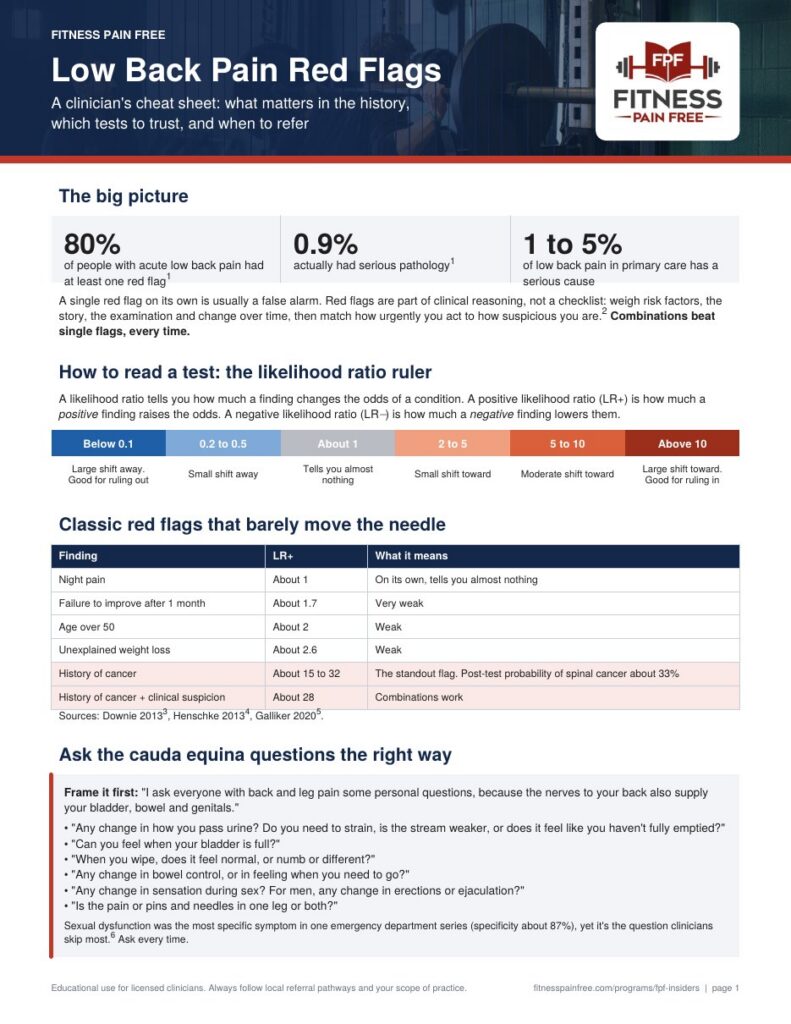
Click HERE to Download FREE
In today’s video I walk through how to screen for serious pathology in patients with low back pain, from the first questions you ask to the tests you perform and the referral decision:
Which low back pain findings should change your plan, and when should you refer? I cover red-flag screening, a practical neurological exam, special tests and referral decisions for clinicians treating active patients and lifters.
The goal is to connect the history and examination rather than relying on a single checklist item. We go through dermatomes, myotomes, reflexes, the straight leg raise and crossed SLR, Babinski, clonus, Hoffmann, vertebral fracture tests and aortic palpation. We also cover cauda equina syndrome, cancer, infection, visceral and inflammatory causes, plus an acute lifting-related radicular pain scenario. Keep in mind that test accuracy depends on the population, technique and reference standard, so interpret every finding in context.
What You’ll Learn About Low Back Pain Red Flags
- Why red flags are common but serious pathology is rare, and how to think about the difference
- How to screen for cauda equina syndrome (and how to ask the questions so patients actually answer them)
- A practical lower-limb neurological exam: dermatomes, myotomes, reflexes, SLR and crossed SLR
- When to add an upper motor neuron screen: Babinski, clonus and Hoffmann
- Screening for cancer, vertebral fracture and spinal infection, including three simple fracture tests
- Visceral, vascular and inflammatory causes of back pain, including abdominal aortic aneurysm
- How to apply all of this to a lifter with acute radicular pain and a young athlete with back pain
Low Back Pain Red Flags: Key Points From the Research
- Red flags are common. Serious pathology is not. In 1,172 primary care patients with acute low back pain, 80.4% had at least one red flag, but only 0.9% had serious pathology, most often a vertebral fracture (Henschke 2009).
- Most malignancy red flags lack support. Only a history of malignancy and strong clinical suspicion had acceptable diagnostic accuracy (Verhagen 2017). A history of cancer raised the post-test probability of spinal malignancy to 33% (Downie 2013).
- Cauda equina red flags are more specific than sensitive. Pooled sensitivity ranged from 19–43% and specificity from 62–88% (Dionne 2019). When they are present, act on them. When they are absent, don’t assume you’re in the clear.
- Check both ankle reflexes. In 530 emergency patients with suspected CES, bilateral leg pain and absent bilateral ankle reflexes predicted compression on MRI (Wood 2024), and 78% of scan-positive CES patients had reduced or absent bilateral ankle jerks vs 12% of scan-negative patients (Hoeritzauer 2021).
- The SLR rules out, the crossed SLR rules in. For disc herniation, the SLR had 91% sensitivity and 26% specificity, while the crossed SLR had 29% sensitivity and 88% specificity (Devillé 2000).
- Upper motor neuron signs are easy to miss. Babinski and sustained clonus were highly specific but had low sensitivity, and Hoffmann had 59% sensitivity and 84% specificity (Rhee 2009). A normal screen doesn’t rule out cord involvement.
- Simple fracture tests help. Older age, significant trauma and prolonged corticosteroid use are the most informative fracture red flags (Han 2023). The closed-fist percussion sign (87.5% sensitivity, 90% specificity) and supine sign (81% sensitivity, 93% specificity) help identify acute compression fractures (Langdon 2010), and the Back Pain-Inducing Test was 99% sensitive (Jin 2020).
- Not all back pain comes from the spine. In 1,000 emergency department patients with back pain, 14.6% had serious non-spinal pathology. Fever (LR+ 68.8) and saddle anaesthesia (LR+ 11.0) were among the strongest red flags (Shaw 2020).
- Abdominal palpation finds bigger aneurysms. Sensitivity for AAA rose from 29% (3–3.9 cm) to 76% (≥5 cm) (Lederle 1999).
- Think inflammatory and think age. Axial spondyloarthritis takes an average of 6.7 years to diagnose (Zhao 2021), and 47% of adolescent athletes with back pain had a spondylolysis vs 5% of adults (Micheli 1995).
Our goal? Help you screen for serious pathology with confidence, so you refer the patients who need it and keep treating the ones who don’t.
Stop second-guessing every back pain evaluation.
Inside FPF Insiders Academy you get 35+ Master Courses that take common pathologies from first visit to discharge (including Lumbar Radicular Pain), 50+ evidence-based cheat sheets (including Low Back Pain Red Flags), live member case breakdowns, and unlimited CEUs for PTs, PTAs and ATs.
Video Timestamps
- 0:00 Low back pain: refer or treat?
- 1:09 Red flags versus serious pathology
- 1:58 Cauda equina screening
- 2:26 Asking the right questions
- 3:47 Lower-limb neurological exam
- 5:36 Straight leg raise and crossed SLR
- 6:18 Reflex findings and cauda equina
- 7:01 Saddle symptoms and urgent referral
- 7:40 Upper motor neuron screen
- 9:36 Cancer and metastatic compression
- 11:18 Vertebral fracture risk
- 12:11 Vertebral fracture tests
- 13:38 Spinal infection
- 14:20 Visceral causes of back pain
- 14:58 Abdominal aortic aneurysm
- 16:10 Inflammatory back pain
- 16:34 Acute radicular pain in a lifter
- 17:47 Young athletes and spinal stress injury
Happy rehabbing,
– Dan Pope DPT,OCS,CSCS
Show Notes / Relevant Articles:
- FPF Mini Course – 7 Reasons Why Injuries Happen in the Gym and What to do About it
- Watch Next: Spinal Stress Injuries in Young Athletes (YouTube)
- Dermatome Testing of the Lower Extremity: Peripheral Neurological Examination for Physical Therapists
- Myotome Testing of the Lower Extremity: Peripheral Neurological Examination for Physical Therapists
- Radicular Lower Back Pain MASTER CLASS For Physical Therapists [Disc Herniation]
- Guide to Diagnosing Spondylolysis and Spondylolisthesis for Physical Therapists
- How to Diagnose Lumbar Spinal Stenosis: A Guide for Physical Therapists
- Disc Flare-Up After Months of Rehab – How to Rebuild a Lifter’s Program After a Setback
- Evidence-Based Manual Therapy Techniques for Low Back Pain
- My Favorite Low Back Pain Rehab Exercises (From a Physical Therapist)
FPF INSIDERS ACADEMY · YOUR FIRST WEEK FOR $1
Become a Confident, Strength-Based Clinician
School taught you rehab, not how to train. Insiders Academy is a guided system for rehab pros who work with active and athletic patients, so you can stop guessing and start practicing with confidence.
- 35+ Master Courses from first visit to discharge
- 50+ cheat sheets to stay current in under 10 minutes (including Low Back Pain Red Flags)
- Unlimited CEUs at no extra cost for PTs, PTAs and ATs
- Real case studies, protocols and a private clinician community
$1 for 7 days, then $25/month · cancel anytime · 7-day money-back guarantee
Looking for other ways to support me that are 100% free?
- Like, comment and share on youtube, facebook and instagram
- Leave a 5-star review on apple podcasts
Thank you!
Dan Pope DPT, OCS, CSCS
References:
- Verhagen AP, Downie A, Maher CG, Koes BW. Most red flags for malignancy in low back pain guidelines lack empirical support: a systematic review. Pain. 2017 Oct;158(10):1860-1868. doi: 10.1097/j.pain.0000000000000998. PMID: 28708761.
- Henschke N, Maher CG, Refshauge KM, Herbert RD, Cumming RG, Bleasel J, York J, Das A, McAuley JH. Prevalence of and screening for serious spinal pathology in patients presenting to primary care settings with acute low back pain. Arthritis Rheum. 2009 Oct;60(10):3072-80. doi: 10.1002/art.24853. PMID: 19790051.
- Finucane LM, Downie A, Mercer C, Greenhalgh SM, Boissonnault WG, Pool-Goudzwaard AL, Beneciuk JM, Leech RL, Selfe J. International Framework for Red Flags for Potential Serious Spinal Pathologies. J Orthop Sports Phys Ther. 2020 Jul;50(7):350-372. doi: 10.2519/jospt.2020.9971. Epub 2020 May 21. PMID: 32438853.
- Dionne N, Adefolarin A, Kunzelman D, Trehan N, Finucane L, Levesque L, Walton DM, Sadi J. What is the diagnostic accuracy of red flags related to cauda equina syndrome (CES), when compared to Magnetic Resonance Imaging (MRI)? A systematic review. Musculoskelet Sci Pract. 2019 Jul;42:125-133. doi: 10.1016/j.msksp.2019.05.004. Epub 2019 May 17. PMID: 31132655.
- Kimber D, Pigott T. Cauda equina screening in Physiotherapy: A qualitative study of physiotherapists in a community musculoskeletal service: Are we asking the right questions and are we asking the questions right? Musculoskelet Sci Pract. 2023 Jun;65:102773. doi: 10.1016/j.msksp.2023.102773. Epub 2023 May 10. PMID: 37201228.
- Wood L, Dunstan E, Karouni F, Zlatanos C, Elkazaz M, Salem KMI, D’Aquino DA, Lewis M. Can clinical presentation predict radiologically confirmed cauda equina syndrome: retrospective case review of 530 cases at a tertiary emergency department. Eur Spine J. 2024 Nov;33(11):4243-4252. doi: 10.1007/s00586-024-08474-5. Epub 2024 Sep 18. PMID: 39292253.
- Devillé WL, van der Windt DA, Dzaferagić A, Bezemer PD, Bouter LM. The test of Lasègue: systematic review of the accuracy in diagnosing herniated discs. Spine (Phila Pa 1976). 2000 May 1;25(9):1140-7. doi: 10.1097/00007632-200005010-00016. PMID: 10788860.
- Hoeritzauer I, Carson A, Statham P, Panicker JN, Granitsiotis V, Eugenicos M, Summers D, Demetriades AK, Stone J. Scan-Negative Cauda Equina Syndrome: A Prospective Cohort Study. Neurology. 2021 Jan 19;96(3):e433-e447. doi: 10.1212/WNL.0000000000011154. Epub 2020 Nov 11. PMID: 33177221.
- Shaw B, Kinsella R, Henschke N, Walby A, Cowan S. Back pain “red flags”: which are most predictive of serious pathology in the Emergency Department? Eur Spine J. 2020 Aug;29(8):1870-1878. doi: 10.1007/s00586-020-06452-1. Epub 2020 Jun 3. PMID: 32495276.
- Rhee JM, Heflin JA, Hamasaki T, Freedman B. Prevalence of physical signs in cervical myelopathy: a prospective, controlled study. Spine (Phila Pa 1976). 2009 Apr 20;34(9):890-5. doi: 10.1097/BRS.0b013e31819c944b. PMID: 19352222.
- Downie A, Williams CM, Henschke N, Hancock MJ, Ostelo RW, de Vet HC, Macaskill P, Irwig L, van Tulder MW, Koes BW, Maher CG. Red flags to screen for malignancy and fracture in patients with low back pain: systematic review. BMJ. 2013 Dec 11;347:f7095. doi: 10.1136/bmj.f7095. PMID: 24335669; PMCID: PMC3898572.
- Henschke N, Maher CG, Ostelo RW, de Vet HC, Macaskill P, Irwig L. Red flags to screen for malignancy in patients with low-back pain. Cochrane Database Syst Rev. 2013 Feb 28;2013(2):CD008686. doi: 10.1002/14651858.CD008686.pub2. PMID: 23450586; PMCID: PMC10631455.
- Han CS, Hancock MJ, Downie A, Jarvik JG, Koes BW, Machado GC, Verhagen AP, Williams CM, Chen Q, Maher CG. Red flags to screen for vertebral fracture in people presenting with low back pain. Cochrane Database Syst Rev. 2023 Aug 24;8(8):CD014461. doi: 10.1002/14651858.CD014461.pub2. PMID: 37615643; PMCID: PMC10448864.
- Langdon J, Way A, Heaton S, Bernard J, Molloy S. Vertebral compression fractures–new clinical signs to aid diagnosis. Ann R Coll Surg Engl. 2010 Mar;92(2):163-6. doi: 10.1308/003588410X12518836440162. Epub 2009 Dec 7. PMID: 19995486; PMCID: PMC3025244.
- Jin H, Ma X, Liu Y, Yin X, Zhu J, Wang Z, Fan W, Jin Y, Pu J, Zhao J, Liu M, Liu P. Back Pain-Inducing Test, a Novel and Sensitive Screening Test for Painful Osteoporotic Vertebral Fractures: A Prospective Clinical Study. J Bone Miner Res. 2020 Mar;35(3):488-497. doi: 10.1002/jbmr.3912. Epub 2019 Dec 4. PMID: 31691366.
- Tande AJ, Currier BL, Osmon DR. Spinal Epidural Abscess. N Engl J Med. 2026 Apr 23;394(16):1621-1633. doi: 10.1056/NEJMra2412728. PMID: 42019020.
- Lederle FA, Simel DL. The rational clinical examination. Does this patient have abdominal aortic aneurysm? JAMA. 1999 Jan 6;281(1):77-82. doi: 10.1001/jama.281.1.77. PMID: 9892455.
- Zhao SS, Pittam B, Harrison NL, Ahmed AE, Goodson NJ, Hughes DM. Diagnostic delay in axial spondyloarthritis: a systematic review and meta-analysis. Rheumatology (Oxford). 2021 Apr 6;60(4):1620-1628. doi: 10.1093/rheumatology/keaa807. PMID: 33428758.
- Micheli LJ, Wood R. Back pain in young athletes. Significant differences from adults in causes and patterns. Arch Pediatr Adolesc Med. 1995 Jan;149(1):15-8. doi: 10.1001/archpedi.1995.02170130017004. PMID: 7827653.