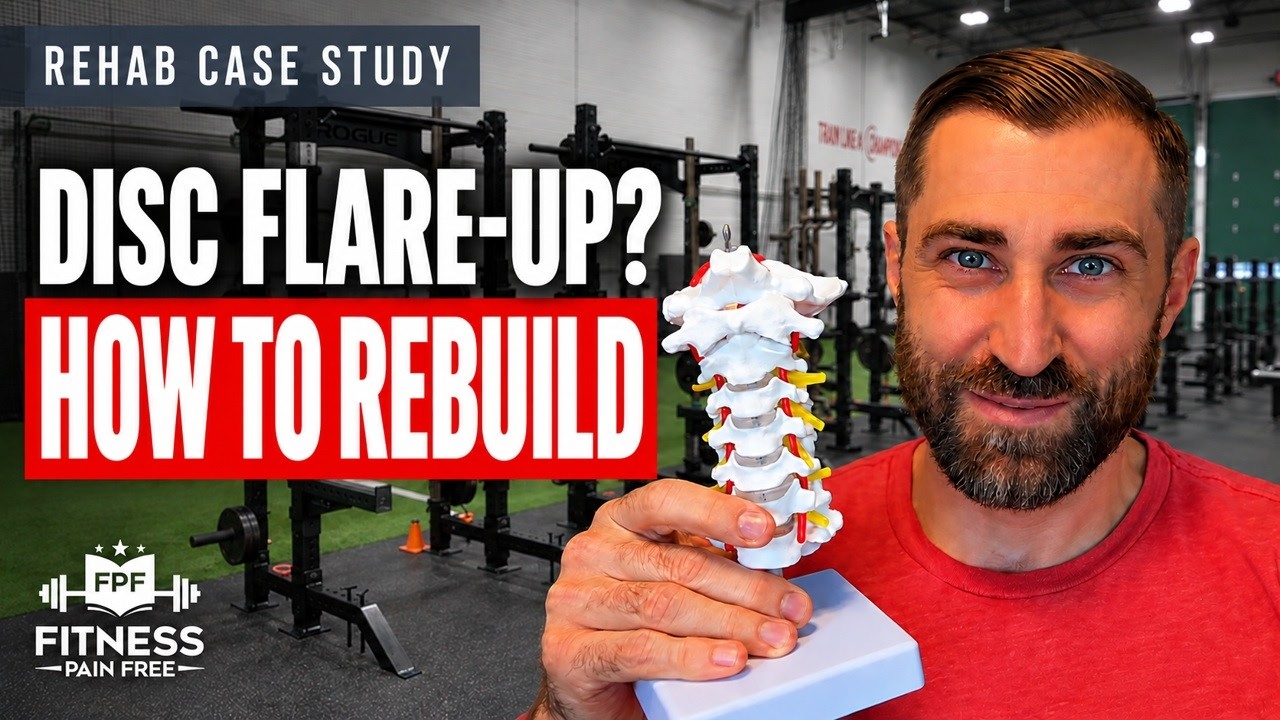
A disc flare-up after months of rehab is one of the most frustrating setbacks you’ll deal with, and to go along with today’s episode I have a nice infographic to share…
Sign up to receive FREE: Radicular Lower Back Pain – The Evidence Based Cheat Sheet
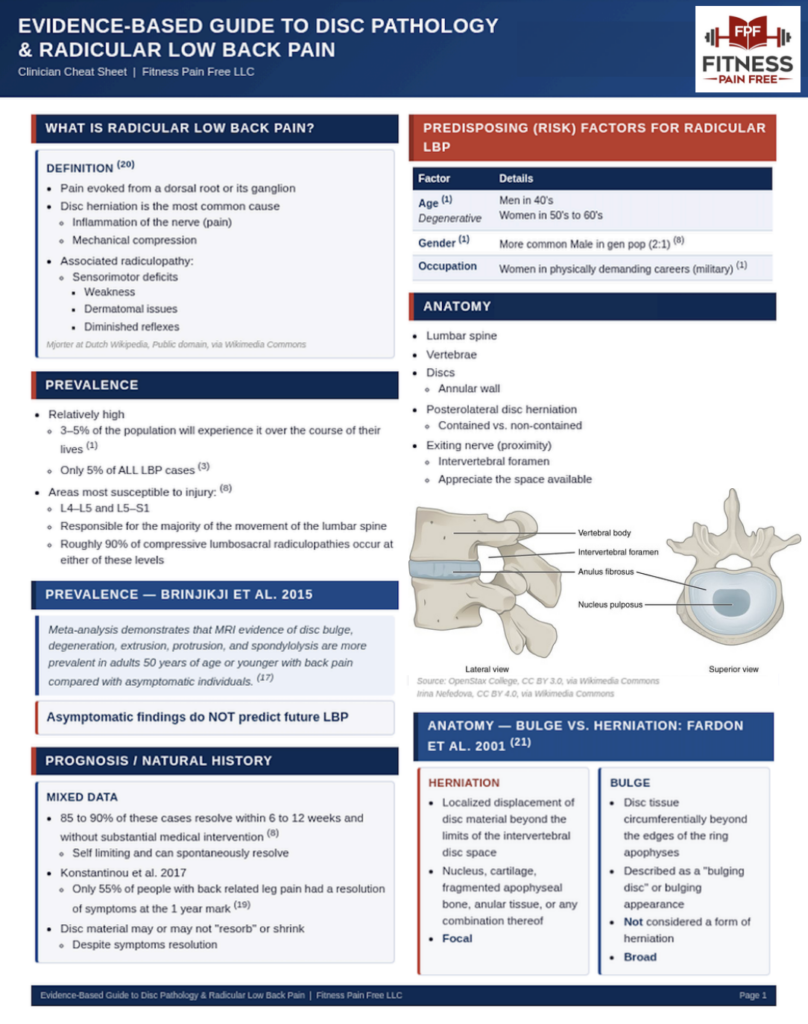
Click HERE to Download FREE
In today’s video we break down a real case: a disc flare-up after months of rehab, and how to rebuild a lifter’s program after the setback:
Your lifter spends 5–6 months rebuilding after a disc injury. Tempo squats, slow progressions, deloads, everything done “right.” They get back to squats and CrossFit… then the leg pain comes back. Now even the warm-up hurts. Do you start the whole program over?
In this live case breakdown, I answer an Insiders Academy member’s question about lumbar radicular pain and rebuilding a training program after a setback. We walk through what went well, what to reassess, and how to find a starting point the athlete can tolerate today. It’s built for physical therapists, rehab professionals and coaches working with lifters and active patients.
What You’ll Learn About Managing a Disc Flare-Up
- How to reassess work, sleep and daily activities after a flare-up
- Ways to modify strength training with upright, single-leg and partial-range exercises
- Where blood flow restriction fits when heavy loading is limited
- How to progress squats and deadlifts back toward normal training
- How to adjust reps, tempo, training volume and reps in reserve (RIR)
- How to set expectations and discuss the next steps with the athlete and coach
Disc Flare-Up Rehab: Key Points From the Research
- Setbacks are normal, not failure. In 250 people who had just recovered from low back pain, 69% had a recurrence within 12 months and 40% had a recurrence that limited activity. Median time to recurrence was 139 days (da Silva 2019).
- Recovery is rarely linear. In 609 primary care patients with back-related leg pain, 55% had improved at 12 months. A patient’s belief that the problem will last a long time was one of the strongest predictors of a poor outcome (Konstantinou 2018), so how you frame the flare-up matters.
- The disc can heal on its own. Spontaneous regression was seen in 96% of sequestrations, 70% of extrusions, 41% of protrusions and 13% of bulges (Chiu 2015). A flare-up doesn’t mean the disc is getting worse.
- Modify for symptoms, not fear. Across 11 studies, 9 found no significant difference in lumbar flexion during lifting between people with and without low back pain (Saraceni 2020). Reducing flexion early can calm things down, but it isn’t a forever rule.
- Keep training. A network meta-analysis of 89 trials found resistance training and stabilisation/motor control exercise ranked among the most effective options for improving function in chronic low back pain (Owen 2020).
- BFR bridges the gap when heavy loads hurt. Low-load blood flow restriction training produced a moderate increase in strength (Hedges’ g = 0.52) and was more effective and tolerable than low-load training alone, though heavy loading still came out ahead when it’s tolerated (Hughes 2017).
- You don’t need to train to failure. Strength gains were similar across a wide range of reps in reserve (Robinson 2024), and stopping sets at 1–2 RIR produced similar quadriceps growth to training to failure over 8 weeks, with less fatigue (Refalo 2024).
Our goal? Help you rebuild your lifter’s program after a disc flare-up so they get back under the bar with confidence, and stay there.
Stop guessing when your lifter’s back pain flares up.
Inside FPF Insiders Academy you get the full Lumbar Radicular Pain Master Course plus 35+ more that take common pathologies from first visit to discharge, live member case breakdowns like this one, 50+ evidence-based cheat sheets, and unlimited CEUs for PTs, PTAs and ATs.
Happy rehabbing,
– Dan Pope DPT,OCS,CSCS
Show Notes / Relevant Articles:
- FPF Mini Course – 7 Reasons Why Injuries Happen in the Gym and What to do About it
- Watch Next: Radicular Lower Back Pain MASTER CLASS (YouTube)
- Radicular Lower Back Pain MASTER CLASS For Physical Therapists [Disc Herniation]
- Lower Extremity Neurodynamics for Radicular Low Back Pain and Disc Herniations [Sliders, Glides, Tensioners, Flossing]
- My Favorite Low Back Pain Rehab Exercises (From a Physical Therapist)
- Programming and Periodization MASTER CLASS for Physical Therapists
- How to Use Auto-regulation to Boost Performance and Reduce Injury Risk
- Lateral Core Training for Physical Therapists (The COMPLETE Guide)
- Evidence-Based Manual Therapy Techniques for Low Back Pain
- The Top 9 Biggest Rehab Mistakes Crossfitters Make: Part 1
FPF INSIDERS ACADEMY · YOUR FIRST WEEK FOR $1
Become a Confident, Strength-Based Clinician
School taught you rehab, not how to train. Insiders Academy is a guided system for rehab pros who work with active and athletic patients, so you can stop guessing and start practicing with confidence.
- 35+ Master Courses from first visit to discharge (including Lumbar Radicular Pain)
- 50+ cheat sheets to stay current in under 10 minutes
- Unlimited CEUs at no extra cost for PTs, PTAs and ATs
- Real case studies, protocols and a private clinician community
$1 for 7 days, then $25/month · cancel anytime · 7-day money-back guarantee
Looking for other ways to support me that are 100% free?
- Like, comment and share on youtube, facebook and instagram
- Leave a 5-star review on apple podcasts
Thank you!
Dan Pope DPT, OCS, CSCS
References:
- da Silva T, Mills K, Brown BT, Pocovi N, de Campos T, Maher C, Hancock MJ. Recurrence of low back pain is common: a prospective inception cohort study. J Physiother. 2019 Jul;65(3):159-165. doi: 10.1016/j.jphys.2019.04.010. Epub 2019 Jun 14. PMID: 31208917.
- Konstantinou K, Dunn KM, Ogollah R, Lewis M, van der Windt D, Hay EM; ATLAS Study Team. Prognosis of sciatica and back-related leg pain in primary care: the ATLAS cohort. Spine J. 2018 Jun;18(6):1030-1040. doi: 10.1016/j.spinee.2017.10.071. Epub 2017 Nov 21. PMID: 29174459; PMCID: PMC5984249.
- Chiu CC, Chuang TY, Chang KH, Wu CH, Lin PW, Hsu WY. The probability of spontaneous regression of lumbar herniated disc: a systematic review. Clin Rehabil. 2015 Feb;29(2):184-95. doi: 10.1177/0269215514540919. Epub 2014 Jul 9. PMID: 25009200.
- Saraceni N, Kent P, Ng L, Campbell A, Straker L, O’Sullivan P. To Flex or Not to Flex? Is There a Relationship Between Lumbar Spine Flexion During Lifting and Low Back Pain? A Systematic Review With Meta-analysis. J Orthop Sports Phys Ther. 2020 Mar;50(3):121-130. doi: 10.2519/jospt.2020.9218. Epub 2019 Nov 28. PMID: 31775556.
- Owen PJ, Miller CT, Mundell NL, Verswijveren SJJM, Tagliaferri SD, Brisby H, Bowe SJ, Belavy DL. Which specific modes of exercise training are most effective for treating low back pain? Network meta-analysis. Br J Sports Med. 2020 Nov;54(21):1279-1287. doi: 10.1136/bjsports-2019-100886. Epub 2019 Oct 30. PMID: 31666220; PMCID: PMC7588406.
- Hughes L, Paton B, Rosenblatt B, Gissane C, Patterson SD. Blood flow restriction training in clinical musculoskeletal rehabilitation: a systematic review and meta-analysis. Br J Sports Med. 2017 Jul;51(13):1003-1011. doi: 10.1136/bjsports-2016-097071. Epub 2017 Mar 4. PMID: 28259850.
- Robinson ZP, Pelland JC, Remmert JF, Refalo MC, Jukic I, Steele J, Zourdos MC. Exploring the Dose-Response Relationship Between Estimated Resistance Training Proximity to Failure, Strength Gain, and Muscle Hypertrophy: A Series of Meta-Regressions. Sports Med. 2024 Sep;54(9):2209-2231. doi: 10.1007/s40279-024-02069-2. Epub 2024 Jul 6. PMID: 38970765.
- Refalo MC, Helms ER, Robinson ZP, Hamilton DL, Fyfe JJ. Similar muscle hypertrophy following eight weeks of resistance training to momentary muscular failure or with repetitions-in-reserve in resistance-trained individuals. J Sports Sci. 2024 Jan;42(1):85-101. doi: 10.1080/02640414.2024.2321021. Epub 2024 Feb 23. PMID: 38393985.